Seven Notrump

In which some people who play bridge blog about it.

Wednesday, November 11, 2009

Do the writers of bridge books get better hands than I do?

I just casually re-skimmed an intro bridge book, prior to lending it to a new player, and I was reminded of how my group's little system has diverged from the standard American we were taught.

One significant shift is in the way we handle powerful hands (also fondly known as rockcrushers, bunker-busters, and other compound nouns that suggest their unstoppable strength).

Classically we're taught to open 2C with a strong hand of 22+ points; 2NT with 21-22; and 3NT with 24-26 points. With fewer than 22 points, open at the one level.

Now, in all my years of playing bridge, I think I've held a 22-point hand once or twice, and never anything stronger. I'm sure it's a fine thing to be able to deal with these beauties when they come up, but if they are so rare, I don't quite see the sense in having so many calls dedicated to magical hands that occur so rarely, when those could be applied to more common situations.

As a result, our little group currently bids:

1NT: 15-17 points and a balanced hand
2NT: 18-20 points and a balanced hand
2C: 20+ points -- can be shaded toward 18 points if you have an especially nice suit, or two nice suits

It seems to work quite well. The potential downsides, I guess, are that it becomes a little more difficult to find the perfect contract when you hold a real atom-smasher, but I have not been blessed with that particular problem much.

What do you think? Are we missing out by adjusting our system this way?

Labels: ,

0 comments:

Post a Comment

<< collapse

Friday, September 19, 2008

Some doubles

"What did her double mean?" is one of those questions that gets tossed around the casual bridge table. (I'll get to "is that forcing?" another time.)

Here is a look at some popular doubles, where they are found, and what they mean.


Takeout double
West
North
East
South
♥ DblPass

This is a double, early in the auction, that asks -- nay, forces -- the doubler's partner to bid a suit. The doubler has opening points and support for the unbid suits.

West
North
East
South
♠ PassPassDbl
Pass

Takeout doubles apply after a preemptive opening just as they do after a 1-level opening. You may pass your partner's double of a preempt only if you are rather sure you can set the contract.


If a player's first bid is a double, chances are that double is for takeout. If the player has bid already in the auction and then doubles on a later round, chances are that double is not for takeout.


Strength-showing double
This is still a takeout double but I'm giving it its own section to call attention to it. Whenever you overcall, you indicate your point count. A jump overcall is the weakest bid you can make that's not a pass. A non-jump overcall is stronger, promising 10+ points. If you have a whopping hand in overcalling position, regardless of your suit distribution, double. This is the strongest bid you can make. It forces your partner to bid.

In the next round, with 13 or so points, pass your partner's suit unless it's awful. If you bid a new suit after your double -- especially at a higher level -- that indicates you have more points.

Responsive double
West
North
East
South
♥ Dbl♥ Dbl

This is a double in response to partner's takeout double. Partner has support for the unbid suits and wants you to pick one -- you have points too, and want him to pick a suit.

West
North
East
South
♥ ♦ ♥ Dbl
It also works when partner has named a suit you don't like, to say you have points but no support for that; can he name his second suit please?


Business double
This is the original double, the double they were doing in the 16th century, also known as the penalty double. It comes when the opponents' auction is drawing to a close and you don't think they can make it; e.g. if you have four trumps in your hand, or if they seemed to be struggling to find a fit.

Matos double
This is a version of the business double. Its actual origin is lost in history, but it's named for Michaelangelo Matos, the dearly remembered founder of this site. A Matos double is a penalty double issued by a player who has a void in the trump suit, having deduced that his partner probably has a lot of trump. The declarer will assume the doubler is the one with the excess of trump, and misplay the hand.

Negative double
West
North
East
South
♥ ♦ Dbl

This form of takeout double occurs after partner has bid and the opponent has overcalled. It says: "I have some points and a suit, but thee opponent got in the way of my naming it." In the diagram, the doubler has spades but fewer than 10 points, so can't bid 2S.

Lead-directing double
West
North
East
South
♥ Pass♠ Pass
♣ Pass♥ Pass
4NTPass♦ Dbl
♥ PassPassPass

This is an opportunistic double, usually in the middle of the opponents' auction. It's clear that the opponents have all the points and are going to play a game or a slam. You double a suit they happen to mention en route, as a way of indicating that this is the suit you'd like led to you if you have a chance of defeating the contract. In the diagram, South wants North to open with a diamond. 4NT is Blackwood, of course.

Lightner double
West
North
East
South
♣ Pass♥ Pass
♠ Pass♠ Dbl
PassPassPass

This is a conventional double. It is a double of a slam bid that sounds like a penalty double (and functions as one, because it's the final bid) but has the conventional meaning of requesting that partner choose an unusual lead, not what he would have led otherwise. The doubler may have a void in a side suit, or honors in dummy's suit, such that a non-standard lead may be the only way to defeat the slam. Sitting North in the diagram, I would lead a heart.

There are plenty more doubles where those came from. What's your favorite?

Labels: ,

3 comments:

  At Friday, September 19, 2008 11:19:00 PM, Blogger Shaz said:

The snapdragon double!!! =D

After the three players before you bid three different suit, a double by you shows moderate values, the fourth suit and tolerance for partnerès suit.

  At Sunday, September 21, 2008 9:48:00 AM, Blogger M said:

lol @ Matos double. I don't even remember that as a maneuver, but obviously I must have been doing that a lot. (lord.)

  At Tuesday, July 07, 2009 7:52:00 AM, Anonymous Plastic Cards said:

Hai! Buddy,

Thanks for giving me such type of information which is useful for my knowledge.

Post a Comment

<< collapse

Friday, June 06, 2008

The dos of DONT

We've been getting along okay without using any of the multitudinous conventions that exist for communicating after the opponents open 1NT, but it is starting to feel like a rather gaping hole in our system.

A convention called DONT -- Disturb Opponents' No Trump -- has the advantage of a charming name, as well as being elegantly easy to remember and deploy. In brief, when overcalling opponents' 1NT, a bid of a suit means you have two suits, with at least 5-4 length: the suit you bid plus another higher-ranked suit.

2C: clubs and another suit
2D: diamonds and a major suit
2H: hearts and spades
2S: just spades, not many points

If you have a single suit, double. Assuming the intervening opponent passes, your partner will bid 2C, after which you bid the suit you like, or pass if it's clubs.

Responses to a suit bid
Assuming the intervening opponent passes, the responder bids like so:

Pass: support for the suit bid
2 of the next suit up: wants you to name your second suit (or pass if this is the one)
2 of another suit: natural, showing 5- or 6-card length
Raise in your suit: likes it, with some strength, but non-forcing
2NT: strong hand, wants to go to game in your second suit. This is unusual.

West
North
East
South
1NT♣ Pass♦ 
Pass♠ PassPass
Pass
Here's an example. After West's 1NT opening, North overcalls 2C, meaning he has length in clubs as well as a higher suit. South responds with the next suit up, meaning she doesn't favor clubs but has probably 3-card length in the other suits. North then bids his second suit, and the contract lands there.

Labels:

0 comments:

Post a Comment

<< collapse

Friday, March 21, 2008

Defense basics: Which suit to lead

Many a contract stands or falls based on this one decision. But you're shooting blind -- you haven't seen the dummy yet. Making inferences from the bidding and from your hand is a fine art, but here are some basic guidelines, in rough order of preference.

Against no-trump contracts:

  • Lead your partner's suit. A good suit is always more powerful when led to, rather than led from.
  • Lead your own longest suit, unless it's one the opponents have bid.
  • If you have to lead a suit that opponents have bid, lead dummy's, not declarer's, suit.
  • DON'T lead a short suit that partner hasn't bid.

    Against trump contracts:

  • Lead partner's suit.
  • Lead a singleton if you have a chance of developing a trump winner. There's little point in leading a singleton if you have, say, KQ of trump, since you have an inevitable trump winner there anyway.
  • Lead an unbid suit, especially one in which you have an honor sequence.
  • Lead dummy's suit.
  • Lead trump if it might prevent dummy from ruffing; e.g. if declarer has shown a long side suit.
  • If you have significant trump length, lead your longest other suit.
  • DON'T lead a suit headed by a lone honor or by a tenace.
  • DON'T lead declarer's side suit.

    Labels: ,

  • 0 comments:

    Post a Comment

    << collapse

    Tuesday, June 26, 2007

    Control bidding

    Blackwood is awfully nice, but it's not always the best way to find a slam; in fact, it's deficient in quite a few ways. Its original intention was not to help bidders fumble their way to a slam, but rather as a method to help them stop short before slam if too many important cards are missing. Blackwood omits any information about voids, and also can leave the asker wondering just which aces have been promised.

    Much more useful in a number of circumstances is control bidding*. Control bidding takes place after a trump suit has been agreed upon. After the agreement, a bid of another suit shows a control in that suit. ctrl A control is a stopper: aces and voids are first-round controls (they can win the first round of the suit); kings and singletons are second-round controls.

    To make a control bid, bid the lowest suit you have a first-round control in; partner will respond with the lowest first-round control he has, and so forth. So directly bidding diamonds denies having a control in clubs, since clubs is lower than diamonds. A bid of the trump suit denies having any more controls, or just shows no interest in slam.

    After you've bid your first-round controls, typically at the four level, you can continue bidding at the five level to show second-round controls if it seems like you want to go for slam.

    Here's an example. You have:

    ♠ A K J 8 3 2
    ♥ 7 5 2
    ♦ -
    ♣ A Q 10 8


    Partner opens 1D, you respond 1S, partner bids 3S to agree emphatically and invite game in spades. Slam is a possibility if partner has control of hearts, so you bid 4C to show your cheapest control and initiate a control-bidding sequence. Partner bids 4H, telling you that he doesn't have a first-round diamond control (which is fine, because your void controls the suit) but he does have a heart stopper -- either the ace or a void. A return to the trump suit would have denied the relevant controls.

    You can now bid 5D, showing your diamond control, reasserting your interest in slam, and denying second-round control of clubs. If partner has second-round control of hearts and thinks slam is a possibility, he'll bid 5H to show that, and you can bid 6S, knowing that you have all the suits stopped; otherwise 5S is a denial bid.

    North
    East
    South
    West
    ♦ Pass♠ Pass
    ♠ Pass♣ Pass
    ♥ Pass♦ Pass
    ♥ Pass♠ Pass
    PassPass
    North
    ♠ Q 10 7 6
    ♥ A K
    ♦ K Q 10 9 8
    ♣ 9 3
    South
    ♠ A K J 8 3 2
    ♥ 7 5 2
    ♦ -
    ♣ A Q 10 8


    What a lovely slam. If, instead of control bidding, you had bid Blackwood, and partner told you he had one ace, you wouldn't know if it was the useful ace of hearts or the useless ace of diamonds.


    *Note that control bidding is also known as "cue bidding," but that's a confusing usage, since the phrase "cue bidding" has another, unrelated meaning: bidding the opponents' suit.

    Labels:

    2 comments:

      At Wednesday, July 04, 2007 11:11:00 PM, Anonymous Anonymous said:

    How then do you show trump controls? My aggressive/crass partnership like to start showing controls early, after a forcing jump raise, just to see what we can see. But we can easily see ourselves at 6H and off AK of trump. Comments?

      At Thursday, July 05, 2007 1:13:00 AM, Blogger Paul said:

    I'm glad you asked, Anonymous. There are a few good ways to talk about trump controls after a control-bidding sequence that covers the other suits. Blackwood is one; especially Roman Keycard Blackwood, which counts the king of trump as a keycard.

    There's also an old convention called the Grand Slam Force (which is sort of a bad name for it) in which a bid of 5NT asks partner to bid 7 of the agreed suit if he has two of the three top trump honors, and less than that if he doesn't.

    For situations where even a small slam is a shaky proposition, bidding 5 of the trump suit is an asking bid: partner should bid 6 holding two of the three top honors and pass otherwise.

    But never fear, 6H is makeable with the AK of hearts missing, as long as you have the other 11 trumps and the trump split is even.

    Post a Comment

    << collapse

    Wednesday, June 20, 2007

    Defense basics: Signaling

    By popular demand, here is a rundown of some simple defensive signals.

    Attitude signals
    When partner leads a suit, to encourage the continuation of that suit (if, say, you have an honor in the suit, or a doubleton with a chance to trump), discard high and then low.

    To discourage the continuation of that suit, discard low and then high.

    Count signals
    When declarer (or dummy) leads a suit, or when attitude is obvious or irrelevant, we signal to show count, not attitude. This helps partner figure out how many cards in the suit declarer holds. Discard high and then low to show that you were dealt an even number of cards in that suit; discard low and then high to show an odd number.

    Suit-preference signals
    When leading a card to partner for her to trump, lead a low card to request the return of the lower of the two other side suits; lead a high card to request the return of the higher one.

    For example: if spades is trump, and you know partner's out of diamonds, lead a low diamond to indicate that you have the ace of clubs (clubs being the lower outstanding suit). Partner will trump the diamond and lead a club to you, which you win, giving you a chance to lead another diamond for another trick. If instead of the club ace you have the spade ace, you should lead a high diamond instead of a low one.

    Lavinthal
    Lavinthal is a special suit-preference signaling convention. When you can't follow suit, you can indicate which other suit you prefer. It's used only the first time you can't follow suit and must make a discard (often when declarer is pulling trump). Discard a card from a suit you do not like. A high card indicates interest in the higher of the other two suits (not trump and not the one you're discarding); a low card shows interest in the lower one. For example, if spades is led and you are out of spades, discard a low club to show interest in diamonds.

    After your first discard, a high card in a suit signals that you would like that suit led to you; a low card in a suit signals that you do not like that suit. So for instance if spades is led and you are out of spades and like diamonds, but can't part with a high diamond to show that preference, discard a low heart (and perhaps next a low club) to show your distaste for those suits.

    Labels: ,

    0 comments:

    Post a Comment

    << collapse

    Tuesday, June 19, 2007

    Defense basics: What card to lead

    Let's standardize on some standard leads. This helps you win tricks as well as giving your partner clues as to what's in your hand.

    Leads when defending against a no-trump contract

    The top card of a three-card or longer sequence that includes an honor.
    KQJ    109843    AKQ7

    This includes broken sequences:
    KQ1063    10975

    and internal sequences:
    AQJ10    Q109854

    If your partner bid the suit, you can lead the top of a two-card sequence:
    KQ4    109543    

    From a long suit without a suitable honor sequence: the fourth card down.
    A98532    KQ87

    From a doubleton: the top card.
    76    K4

    From three low cards: the middle card, then up, then down (aka MUD).
    765    932

    From three cards headed by an honor: the low card.
    K98    AJ3

    Against a trump contract, some principles are different.

    Lead the top card of a two-card or longer honor sequence.
    KQ4    109543    AKQ7

    From three cards headed by an honor: the low card, unless that means leading away from an ace.
    K98    AJ3

    From a long suit without a suitable honor sequence: the fourth card down, unless that means leading away from an ace.
    A98532    KJ874

    Labels: ,

    0 comments:

    Post a Comment

    << collapse

    Monday, April 16, 2007

    Weak jump overcalls

    With the onset of weak two bids, some ambiguity has been uncomfortably introduced regarding the meaning of an overcall at the two level. Following a 1S bid from the enemy, does 2H show 13 points and 5 hearts? 7 points and 6 hearts? Maybe 10 points and 4 hearts? Ambiguity has its inevitable place in bidding, but this is not a good place for it.

    I propose that we standardize on the popular system of weak jump overcalls, though it might feel unintuitive at first.

    A jumping overcall is the equivalent of a preemptive weak-two opening bid, showing say 7-11 points and a six-card suit; in the case of the overcall, though, the suit ought to be quite solid, without more than one missing honor.

    A nonjumping overcall at the one level shows 10 points and a five-card suit (unless Bryan is the bidder; Bryan likes 13-point overcalls only.) A 1NT overcall shows standard 1NT opening, with the addition of a stopper in the enemies' suit. A nonjumping overcall at the two-level is strong, showing opening points and a good suit, except as spelled out below.

    If you have a mammoth 18+-point hand, just double and bid your suit next round.

    The quirk to remember

    If you would have to jump to the three level -- e.g., opener bids 1H and you have six good diamonds and a weak hand -- don't jump, except to show seven cards. Your nonjumping overcall is thus either strong or weak, which will be clarified by your rebid.
    Responder should bid if she has 10 points or good trump support. Raise partner in his suit to invite to game. A new suit is forcing for one round. NT is limiting, around 10 points and a stopper in opponents' suit.

    When the bidding comes back around to you, the overcaller, pass or return to your suit cheaply if your initial overcall was weak. Any other bid implies that it was strong and forces to game.

    Labels:

    0 comments:

    Post a Comment

    << collapse

    Tuesday, March 06, 2007

    Ogust

    After an interesting evening of exploring weak twos, I don't think we're at all ready to abandon the concept (as Caroline suggests) but one improvement at least is called for. The opener's rebid over a 2NT response to a weak-two opening, indicating a feature in a side suit, was not terribly useful. Mr. Harold Ogust agreed, and invented the Ogust convention (slightly modified below):

    You open a six-card suit with a weak-two bid.

    Your partner has 12+ points and likes the suit, and thinks you have a shot at game. To evaluate what a good final contract would be, she bids 2NT. This asks you to describe your hand as follows:

    • Respond 3C if you have minimum points and a poor suit (only one of the three top honors [AKQ] in your bid suit).
    • Respond 3D with minimum points and a good suit (two of the three top honors in your bid suit).
    • Respond 3H with maximum points and a poor suit.
    • Respond 3S with maximum points and a good suit.
    • Respond 3NT if you have all three top honors in your bid suit.


    That information should allow responder to pick an appropriate contract in which to play.

    Labels:

    0 comments:

    Post a Comment

    << collapse

    Monday, March 05, 2007

    Weak twos

    There's been a lot of buzz, but I believe it's time to give this a try for real. An opening bid at the two-level does not mean what it used to. Memorize what follows (or comment with quibbles and alternate suggestions).

    Open 2D, 2H, or 2S if you have exactly six cards in the suit and 6-10 7-11 points. Your points should lie primarily in the bid suit, and you should not have a four-card side suit (especially not a major).

    With a strong hand, open 2C. This promises 20 or more points (or a couple less with a great strong suit) and says nothing about your club holding.

    Responses to a weak-two opening

    You're not forced to respond.

    • With a doubleton at least in partner's suit and 7-13 points, you can raise in the same suit. Opener should pass.
    • With a longer fit and greater than opening strength, jump to game.
    • With a five-card suit and good point count, bid that suit. To bid at the three level, you should have a six-card suit and/or 15+ points.
    • To invite partner to game, bid 2NT. This promises 14+ points and invites the opener to show a feature in another suit -- an ace, king, void, or singleton -- by bidding that suit at the three level. If opener has none of the above, she rebids the original suit. If the original suit is rock-solid -- headed by three honors, say -- she can rebid 3NT. See Ogust.
    • To invite partner to slam, bid 4NT: Blackwood!

    Responses to a 2C opening

    You are forced to respond.

    • With 7+ points and five diamonds, hearts, or spades, bid that suit at the two level.
    • With 7+ points and balanced distribution, bid 2NT.
    • With less than seven points and/or no particular suit you like, bid 2D. Opener will name her favorite suit. You are still forced to respond -- raise that suit to the three level if you like it okay and have five or more points, or bid 3C as a sign-off if you have very low points and nothing else to offer.

    Labels:

    4 comments:

      At Monday, March 05, 2007 3:19:00 PM, Anonymous Anonymous said:

    tell me you are not going over to the dark side! oh, how i loathe weak 2 contracts. (i know, let's get in a partial to play out a lousy hand versus some opponents who probably have something better!) perhaps if i just keep not playing very often by the next time i do, you will all have come to hate them, too.

    caroline

      At Monday, March 05, 2007 4:18:00 PM, Blogger Paul said:

    let's get in a partial to play out a lousy hand versus some opponents who probably have something better

    That's it exactly! Over a weak-two opening, the opponents don't have a chance to find their fit, and they can't set us in our long suit. The hope is that it'll produce more aggressive, competitive play, as opposed to the current climate wherein everyone politely, patiently bids to describe their hands and whomever has the best fit and the most points is allowed to calmly reach and play their ideal contract -- undoubled of course. And two-bids are almost never seen.

      At Monday, March 05, 2007 10:27:00 PM, Anonymous Anonymous said:

    Hmm. Well, a couple things: it seems to me that the way to get people to play more aggressively is to play more agressively and egg people on a bit. That is, you can play weak twos just for the sake of playing them, and it won't necessarily make you a more aggressive player.

    That said, the bit about the long suit might lessen the suckage. I've not seen that as a prerequisite to the weak two bid before, and everyone ends up getting set, which is what I was imagining, not poor ops don't get to play their suit.

      At Monday, March 05, 2007 11:42:00 PM, Blogger Paul said:

    How did/do the Columbia people play their weak twos -- just with five-card suits? That sounds too weak.

    I agree that bidding more aggressively is a good way to encourage others to do the same; but without the conventions in place to support aggressive bids all you can do, besides doubling often, is stuff like open 11-point hands at the one level, etc., and doing that tends to get you set repeatedly, because you're bending the rules and nobody else is. That -1700 rubber from February 20 at Marya's is a sad artifact of that sort of aggression.

    Post a Comment

    << collapse

    Tuesday, October 17, 2006

    Homegrown refinements

    As a somewhat newish player, I'm hesitant to stray far from the precepts of the cheat sheet I learned from. But we have made a few deviations, largely according to the wisdom of Bryan, and I'd like to enumerate those for everybody, in part to avoid fouled-up Stayman contracts like the one I played last night.

    1. STAYMAN
    The cheat sheet says, for example, that you can respond to 1NT holding a five-card minor suit with 6 points, which is what screwed us up last night. That's great but incorporating four-suit transfers into Stayman seems to work better. If I may loosely quote myself, for the record:

    To respond to a 1NT opening, you should have 8+ points. A response of 2D shows five hearts, 2H shows five spades, 2S shows five clubs and no four-card major, and 2NT shows five diamonds. To show a balanced hand, bid 2C and then rebid 2NT when it's your turn again. (Any of these bids can be made at the 3-level instead, which promises maybe 12 points and is forcing to game.) A 2C response is Stayman, showing at least one four-card major suit. Responses by opener to 2C are: 2D in the absence of a four-card major; 2H with four hearts (may also have four spades); 2S with four spades (implies fewer than four hearts). Memorize this.

    2. OVERCALLS
    The cheat sheet says you can overcall with 8 points; if you have opening strength, make a jump overcall. That's great but its primary usefulness seems to be gumming up the opponents; it doesn't give partner, who'll have his own chance to bid anyway, very much information. We've started requiring 13 points for an overcall. I'm happy to hear opposing views on this though.

    3. MEDIUM TWOS
    The cheat sheet says if you have 18-21 points, you must bid one of a suit and then jump shift. An opening bid of two of a suit promises game in your own hand. That's great but as I have complained before, I often get passed before I can jump. That's why we've been saying that you can bid two of a suit with 18-22 points, which is forcing for one round. Nobody's ever been dealt game-in-hand in my experience, not even Twenty-Point Jeff, so I'm not terribly worried about how to deal with that situation.


    If you play with us and you see that I'm leaving something important off the list, please let me know. If you don't play with us and one of the things I'm proposing seems wrongheaded, please please let me know, gently.

    Labels:

    0 comments:

    Post a Comment

    << collapse

    Monday, August 14, 2006

    Cheat sheet

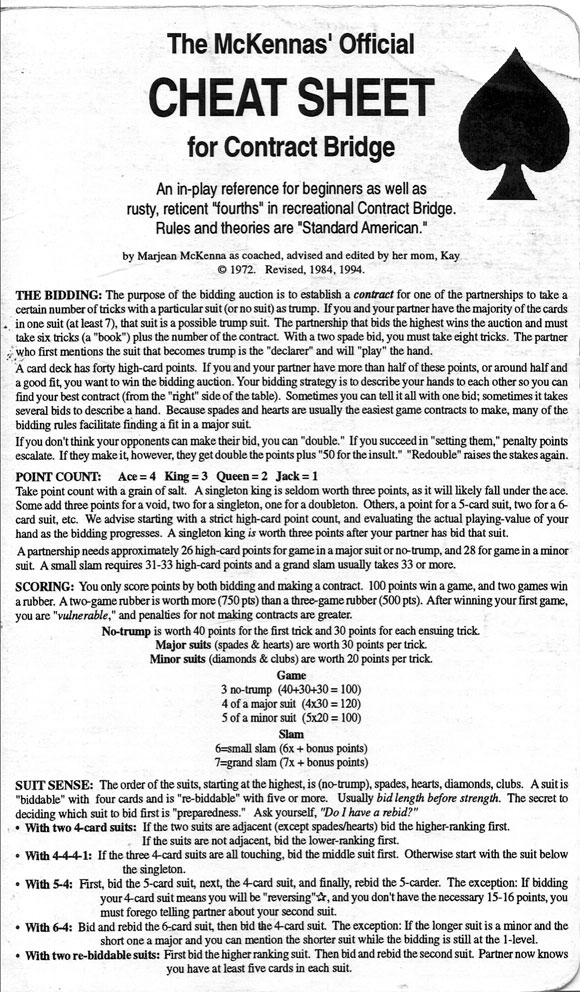
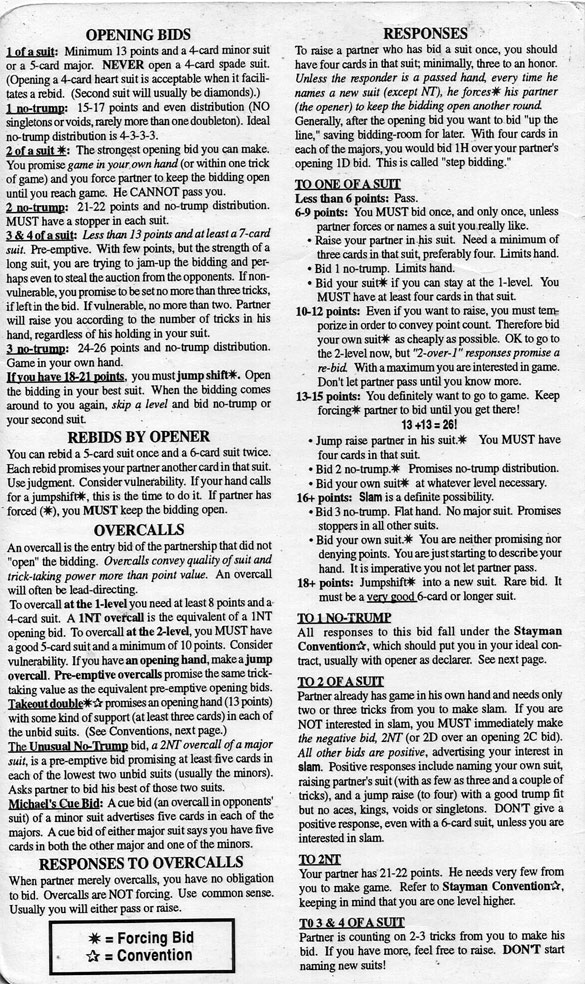
    I learned bridge from Alexa, who learned from her family. When she took on the responsibility of teaching us, she passed out her family's official bridge reference card ("for beginners as well as rusty, reticent 'fourths'"), which still stands as an authority in my circle, although we do question a couple of points. It's great to have on hand during a game -- even if you've got it all memorized, chances are someone else at the table could use a refresher.

    Apparently there's a new edition that obsoletes the one we learned on, but I don't have it. Meanwhile, the nice laminated copies have become very scarce, so here are scans for those who wonder why I never underlead an ace, et cetera:

    Cheat Sheet, page 1   Cheat Sheet, page 2   Cheat Sheet, page 3   Cheat Sheet, page 4

    Labels:

    0 comments:

    Post a Comment

    << collapse